Focus area · AI & Agentic Behavior

The AI shift is moving fast. Adoption is moving unevenly.

A small number of mostly private players are racing ahead — capital, talent, and the willingness to push aggressively. The broader market is hesitating, for reasons that are rational. Our practice sits in that gap, helping organizations understand, design, and govern AI systems through three lenses: adoption, safety, and the design of agentic systems themselves.

Three themes, three audiences

Where this practice does its work.

Each theme is anchored in a stakeholder who feels it most sharply. The themes are not separate services — they are three angles on the same shift.

01

For private sector & corporate leaders
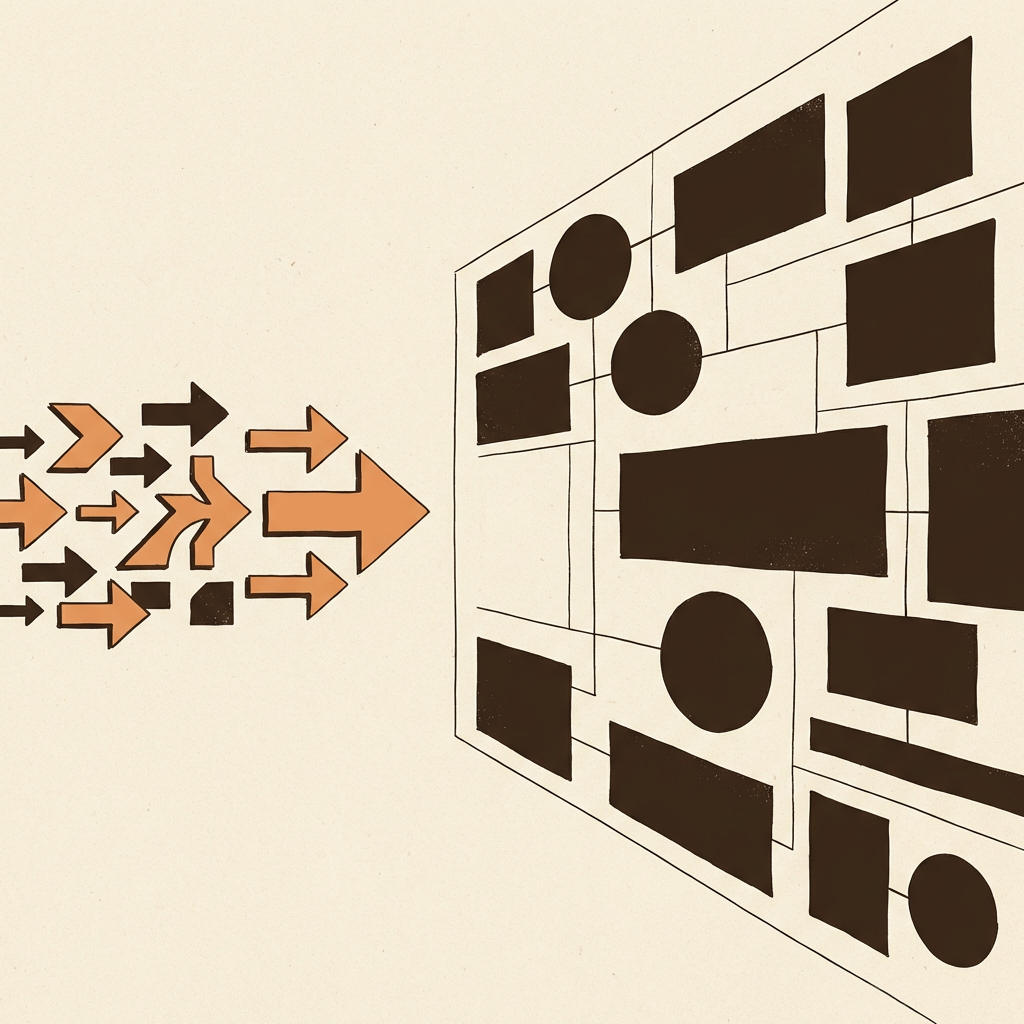
A small flock of orange arrows pushing toward a dense wall of brown geometric blocks — the asymmetric tension between AI's frontier and institutional adoption.

AI Adoption

Adoption is the bottleneck, not capability. A small number of mostly private players are racing ahead; most of the market is hesitating — for reasons that are rational, not just emotional.

Inside large organizations, the gap between what AI can do and what teams will actually use is widening. Mistrust, unclear accountability, brittle workflows, and the sense that AI is being done to people rather than with them all slow things down. We help leaders read that resistance as signal, not friction — and design adoption strategies, internal narratives, and product decisions that earn trust instead of demanding it. Where useful, we read the adoption data itself: where usage drops off, which cohorts stall, which workflows actually stick.

In practice

  • Adoption diagnostics
  • Trust-calibration design
  • Internal AI rollouts
  • Demonstrated-possibility prototypes

02

For public sector, civil society & social impact
A warm orange sun radiating fine ink rays down onto a quiet field of small marks — persuasion at population scale, made visible.

AI Safety

Safety at population scale is a behavioral question, not just a technical one. Agents are persuasive by construction — and that becomes a public-interest concern long before it becomes a policy one.

Always-on, warm, authoritative systems shape attention, belief, and behavior in ways earlier media never could. The risks — manipulation, dependency, eroded judgment, asymmetric influence, opaque data use — sit squarely with regulators, civil society, and the institutions responsible for collective welfare. We work with them to make AI legible: what these systems are doing, to whom, on what data, and what guardrails actually bite.

In practice

  • Behavioral risk framing
  • Oversight & disclosure UX
  • Evidence for policy
  • Persuasive-surface red-teaming

03

For product companies & teams
A leaning stack of brown screens dissolving into particles that reorganize into one clean orange arrow pointing forward — artifacts giving way to intent.

AI Systems

When the system can generate the artifact, the design problem moves up a level — to the behavior of the system itself.

Traditional design craft is partially commodified by generative tools. The new frontier is designing the behavior, judgment, and interaction patterns of agentic systems themselves: how they interpret intent, when they should act and when they should ask, how oversight is exposed in the interface, and how the relationship stays sound over time. A big part of that work is data: how the system consumes signal, how it surfaces it back to people, and how data products get designed around behavior rather than the other way round. We work with product teams to redesign their process, their primitives, and their definition of quality for this shift.

In practice

  • Intent modeling
  • Agent interaction design
  • Oversight affordances as UI
  • Data products for behavior
  • Behavior-led product workflows

Positioning

Fabric's AI & Agentic Behavior Practice helps organizations understand, design, and govern AI systems through three lenses: adoption, safety, and the design of agentic systems themselves.

Related

Designing, deploying, or governing an agentic system?

Tell us what you are trying to build, regulate, or make sense of. We come back with a focused way in — usually a prototype, a workshop, or a sharp first question.